Feel free to let me know what you think about the book by either leaving a review on Amazon or emailing me at henrypaget976@gmail.com. I’m always looking for constructive feedback so I can improve.
Have you ever been in a group where you’ve done or seen something you would have never expected?
Many of my worst moments occurred when I got caught up in the group’s madness.
My first time drunk
I was at a friend’s house with two other close friends at the time (around 11 years ago, when I was 16).
My friends were a couple of years older than I, and we had a free house for the night as my friends’ parents were away.
My friend invited a group of people to the house
I didn’t know these people very well, but they were my friends’ friends, and they brought a large bottle of Smirnoff vodka with them.
Everyone had a shot of vodka, and then all of a sudden, my friend and I just kept on being given shots of it (there was peer pressure, and everyone was encouraging us to continue drinking these shots).
After a few shots, I blacked out.
The next thing I remember, I was vomiting in my parents’ house ( apparently, I fell over as well).
I was in an awful state, and from what I can remember, the paramedics were called to come and see me.
The madness of the group came above the health of its members
And from that point on, I knew of the madness of the group. I never made the same mistake again.
It was a learning curve to realise that people you would call friends may not always have your best interests at heart when caught up in the emotions of the group.
The madness of the gladiatorial games
I visited Rome in April and went to the Colosseum, where I learned about what really happened there.
Romans executed Christian martyrs, sent gladiators to their deaths, and slaughtered thousands of animals to thrill the mob.
Human nature is full of evil and vice; that’s why we must work towards virtue, as the Stoics and Christians have done. When we’re in a group, this evil and vice can compound if we don’t discipline our character
We have two choices :
Hang around with the timid masses who never know victory nor defeat. The uninspiring, undisciplined masses change their moods like the weather and follow the crowd without ever thinking for themselves.
Choose friends who are virtuous and who don’t unthinkingly do whatever the crowd is doing; ruthlessly discipline ourselves to be freethinkers, always with virtue in mind.
Above all, remember this:
Don’t get caught up in the emotions of the crowd.
You have your own mind, use it.
No one can force you to behave in a way contrary to virtue and your nature.
One time at St James’ Park
Years ago, I was at Newcastle United’s stadium (St James’ Park) watching the football match between Newcastle United and Sunderland.
It’s a local derby (or grudge match), and the tensions were high all day.
Sunderland beat Newcastle 3-0, sparking uproar throughout the city of Newcastle.
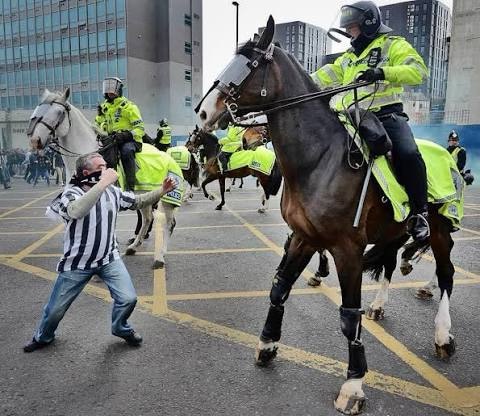
One man punched a police horse.
Crowds of people smashed up Newcastle; they set bins on fire, and glass bottles shattered all around me.
This one poor taxi driver was being rocked back and forth by twenty angry supporters pushing his car from side to side near Central Station ( the main train station in Newcastle).
All of this madness because of a defeat in a football match.
Madness is in human nature, and it has the potential to cause havoc in a group.
Never get consumed by the madness of the group.
I was inspired to write this article by Seneca’s quote:
“ Certainly, the greater the mob with which we mingle, the greater the danger.”
I share ideas that challenge how you think and help you grow — all for free.
“We need to set our affections on some good man and keep him constantly before our eyes, so that we may live as if he were watching us and do everything as if he saw what we were doing.” – Seneca the Younger
Who inspires you? Who morally do you respect and admire?
These are important questions because when we have a benchmark against which to measure ourselves, we are more likely to achieve success than if we have no points of reference.
Whatever you do, don’t measure yourself against a bent ruler.
The people whose character we should try to imitate are people who embody virtues.
For example, Christians aim to be Christ-like and measure themselves up against Jesus Christ.
The Stoics aim to embody good character and good deeds through practising virtues such as self-control, courage, justice and honesty.
Prominent Stoics were Marcus Aurelius, Seneca and Epictetus.
Benjamin Franklin also aimed to live a virtuous life ( so he can be a good role model for benchmarking one’s character against).
Also, in Christianity, the saints are good examples of good character.
You may have people in your life that you admire and aim to model certain character traits in yourself.
When you admire a character trait in someone else, aim to cultivate that in yourself.
For example, if you’re jealous of someone’s erudition, temperance, etc., that’s a clear sign that you should cultivate those traits in your character.
Alternatively, when we dislike something about someone’s character, we also dislike that in ourselves.
The aim is to model our behaviours from people who embody virtue.
And if they can embody virtue, we can learn from them to live virtuous, worthwhile, effective lives.
The ultimate goal is to live a saintly or virtuous life; all other achievements are byproducts of this.
To live an immorally wicked life with no sense of virtue leads to a life full of pain.
There are plenty of examples out there of this. You don’t have to look far.
The key to human flourishing is living a virtuous life.
Do you want to flourish?
The singer Bob Dylan wrote a song called You’ve Got to Serve Somebody.
Bob is a Christian, and he chose to serve god.
When you serve God honestly, you aim to live your life by following virtues rather than vices. (Look up the seven heavenly virtues and the seven deadly sins.)
So by following god, you essentially serve virtues and aim to limit vices.
If you have no sense of who you’re serving, you’re probably serving the wrong things.
P.S. You don’t have to be religious to live a virtuous life.
Click here to join my 5-bullet Friday newsletter. Every Friday, I share five thoughts, insights, quotes, products, recommendations, etc. that have helped me and might also help you.
This quote is one that Seneca quotes (from an unknown poet) in Letters from a Stoic, though Seneca’s original quote is:
“a man is unhappy, though he reigns the world over, if he does not consider himself supremely happy.”
And I think Seneca is absolutely correct.
If we cannot be happy with our lot in life now, when can we be?
I guarantee that if you say, “I’m happy when I get this car or this house, etc., “ when you get what you want, the goal posts will move even more.
“What a shame it is to get what we wanted”. – anonymous
I heard the above quote somewhere, yet I can’t remember the source.
But it points to the fact that we tend to vastly overestimate how we will feel when we achieve a given goal.
Seneca also talks about how the best part of a work of art is the painting and not the underwhelming feeling of it being finished and then moving on to the next piece of artwork.
Finishing anything is such a small part of the whole process.
Seneca also wrote that when children are raised, seeing them flourish in the world as adults is pleasant, but it’s a byproduct of raising and caring for them in infancy.
And that it’s the raising and caring for children in their infant years that is looked upon most fondly ( I hear this echoed amongst many parents).
The Takeaway is that we should be happy with what we have. Yes, it’s fine to have goals and strive for them, but chronically being unhappy with your lot in life and always wanting more is a disease.
We should care more about sowing and less about reaping.
Things can always be better, but they can also be worse. If we want peace, we need to think of the latter.
A quick story:
Almost a year ago, I had wrist surgery to repair torn cartilage.
For the first six months after surgery, all was going well, then as I was pulling my car door (which I’ve done many times after surgery), I felt a pull and as a consequence pain in my wrist.
This pain has continued even while I write these words, and it’s looking ever more likely I’ll need to undergo wrist surgery again.
I’ve been feeling down in the dumps and repeating in my mind, “I just want my wrist to be normal again”.
But this has been making me suffer more.
So, I’ve thought to myself, “There is always someone worse off than me.”
I think of the poor children in Gaza, god bless them, who are suffering unimaginable horror and going through much worse than I.
When I think about my injury in this context, it’s made my wrist pain much more sufferable.
Click here to join my 5-bullet Friday newsletter. Every Friday, I share five thoughts, insights, quotes, products, recommendations, etc. that have helped me and might also help you.

 henrypaget.com