For a year, I had chronic wrist pain due to ego lifting in the gym when I was doing some weighted chin-ups.
I felt my wrist pop while doing weighted chin-ups on the descent.
It only took me a year to realise I tore some cartilage in my Wrist.
I had to have surgery to fix the cartilage in my wrist, and now I’m pretty much back to normal.
I would hate for you to get injured from lifting weights.
And I would hate for you to feel the way I did during that year of chronic pain.
So, here are my eight golden rules for weightlifting, which will help you avoid injury.
- Always use perfect form. When bench pressing, tuck your elbows in so they don’t flare out ( this will protect your shoulders from getting injured). In the deadlift and squat, never round your back.
- Always use a full range of motion when lifting weights. When you squat, go ass to grass, and when you bench press, touch the bar against your chest. If you can’t go full ass to grass when you squat, try to go as low as possible and as comfort allows (no pain).
- Don’t lift too heavy, too soon. Progress slowly but surely, don’t just load all the weight on the bar to do one sloppy rep. Progress slowly with perfect form. Here’s a good progression method for beginners. I’m using an example for the squat. Week 1: lift three sets of 5 reps with 50kg on the barbell squat. The following week, aim to lift three sets of 5 reps with 52.5 kg. Then repeat this for as many weeks as possible until you can’t perform three sets of 5 reps. When this happens ( a plateau), reduce the weight by 10% and start the progression again. This is called linear progression, and it’s popular in Mark Rippetoe’s book, Starting Strength. At the end of the article, I’ll give you a free strength training program.
- Always warm up properly. I warm up like this: first set lift 50% of my working weight for 8 reps, second set lift 70% of my working weight for 4 reps, and lastly lift 90% of my working weight for 2 reps, then I’m ready to perform my work sets. Say, for example, I’m going to bench press 100kg for 5 reps (working sets). Here’s how the warm-up sets go: set 1, 50kg x 8 reps, set 2, 70kg x 4 reps, set 3, 90kg x 2 reps. Failing to warm up correctly can cause your muscles to be stiff and tight and more susceptible to injury. Warming up ensures your muscles and joints are warm and have more synovial fluid flowing through them, thus they will move better. By working up to your heavy sets, you allow your muscles to adapt to the heavy loads slowly in a way that they can easily manage. The day I injured my wrist, I went straight into heavy chin-ups without warming up for this exercise; it’s no wonder I got hurt.
- Don’t compare yourself to other weightlifters. Focus on being a little bit better today than you were last time you worked out, even if that’s just adding one rep or only adding a small amount of weight to the bar. Over months and years, small progress is enormous progress. Like compound interest, your body and muscles will benefit from years of slow progression in the gym. Slow progress is good progress. Fast progress is more likely to cause injury. Slow progress is desirable.
- Keep hydrated. I like to have a glass or two of water before I work out. Staying hydrated is vital for every physiological process in your body. Make sure you’re always hydrated. A good daily water intake I recommend is to drink at least 1 litre of water for every thousand calories you consume, plus an additional litre for every hour you work out. This is around 3-4 litres of water for most people daily.
- Lift weights in a controlled fashion. You should always control the weight you lift; if you’re not controlling it entirely, you’re lifting too much weight. Decrease the weight on the bar and ensure your muscles are doing all the work. At gyms, I’ve seen people dive bombing their squats (where they almost just drop their body to the floor and bounce back up). When this happens, your muscles aren’t firing correctly. I’ve also seen people round their back during deadlifts ( when they assume a frightened cat’s posture), which will eventually cause injury. Your back should be flat when you deadlift and squat. When you round your back, your joints take much of the load, whereas your muscles should carry and control the load.
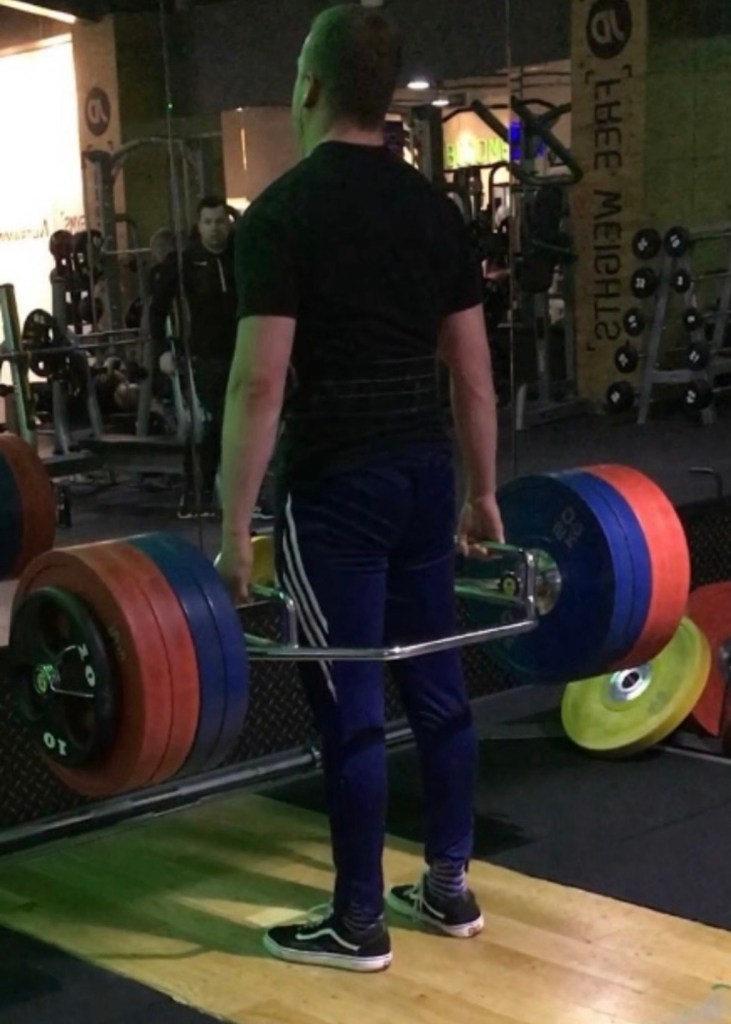
- Only use exercises that you can safely perform or that feel most comfortable. For example, I’ve both barbell conventional deadlifted and trap bar deadlifted, and the one that feels the best for me is the trap bar deadlift. So, this is the variation I mostly perform. Try different exercises and see what your body responds to best. Don’t persevere with an exercise that’s causing you pain. Your body is trying to tell you something.
Here Is A Sample Starting Strength Workout Routine Using Linear Progression.
Week 1
Day A ( Monday)
Squat 3 Sets Of 5 Reps
Bench Press 3 Sets Of 5 Reps
Deadlift 1 Set of 5 reps
Day B (Wednesday)
Squat 3 Sets Of 5 Reps
Standing Overhead Press 3 Sets Of 5 Reps
Deadlift 1 Set Of 5 Reps
Day A ( Friday)
Squat 3 Sets Of 5 Reps
Bench Press 3 Sets Of 5 Reps
Deadlift 1 Set of 5 reps
Week 2
Day B ( Monday)
Squat 3 Sets Of 5 Reps
Overhead Press 3 Sets Of 5 Reps
Deadlift 1 Set of 5 reps
Day A (Wednesday)
Squat 3 Sets Of 5 Reps
Bench Press 3 Sets Of 5 Reps
Deadlift 1 Set Of 5 Reps
Day B ( Friday)
Squat 3 Sets Of 5 Reps
Overhead Press 3 Sets Of 5 Reps
Deadlift 1 Set of 5 reps
Repeat this cycle for 12 weeks, then have a deload week ( no lifting), just going on walks.
Click here to join my 5-bullet Friday newsletter. Every Friday, I share five thoughts, insights, quotes, products, recommendations, etc. that have helped me and might also help you.
 henrypaget.com
Leave a Reply